Wednesday, 15 May 2024

The Closed Hand by Foxymoron

The above expression is given in the dictionary as the "declarer hand in bridge", but I was surprised that two other meanings of which I was aware were not given. One is the acknowledgement of defeat (or the greeting at the start) in a two-player match such as snooker by the touching of a closed hand. The other, with a black closed hand, is the symbol of the #BlackLivesMatter movement.

It is the first meaning that is the theme of this week's blog, which features an interesting hand from the SIMs at the Woodberry on Tuesday.


Three pairs reached the pushy slam. One was in 6H by East going off, one was in 6H by West making and finally one was in 6S by East going off. There is nothing to choose between the contracts you might think as all of them require guessing the spades. Let us say that you are playing 6H by East on the lead of the eight of clubs. You win and draw three rounds of trumps ending in West.

Now you lead the queen of spades from dummy and North covers perforce while you win with the ace. Now the right line is to run the nine. Suitplay, the omniscient computer program, tells me this is wrong and you should cash the jack. It is an excellent piece of software by the way. It is freeware and can be downloaded at SuitPlay (jeroenwarmerdam.pythonanywhere.com)

However, it has to make some assumptions about what the defenders do and do not know, and this is where the "closed hand" comes in to the picture. If a defender can see the eight and the nine, he or she should duck with Kx and cover with KT doubleton when the queen is led. If the defender cannot see the eight and the nine, he or she should cover with Kx. So, here, if you are playing it from the East hand, you should play North to have Kx (or singleton king) and run the nine on the second round. If you are playing a slam from the West hand, then you should play for North to have covered because he has KT doubleton, and play as Suitplay does and cash the jack.

There was not much difference playing in Six Spades, again by East on a club lead. Declarer crossed to the ace of hearts and led the queen of spades but David Herbert subsequently went off. As Pope said:

A little knowledge is a dangerous thing
Drink deep or taste not the Pierian spring.

Oscar Wilde quipped:  ‘There are two ways of disliking poetry. One way is to dislike it, and the other is to read Pope.’

Mike Bull and John Bernard were the beneficiaries of 6S-1 and this helped them to a near top, and a fine win nationally with 66.18%. And why should North cover from Kx, which Suitplay regards as "not optimal"? Well, just consider for a moment how you would feel if South had T9x or T8x and you duck ...

As your scribe was not there, I relied on Graham Osborne's excellent booklet to write my blog. Another interesting hand which helped the winners to their national success was the following.
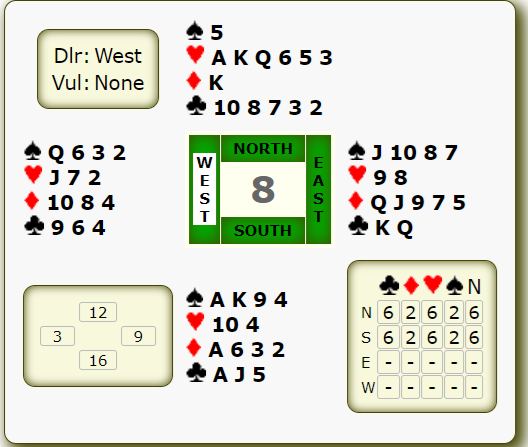

The key on this hand is not to bid slam, which might well fail, but to play it in no-trumps and Bull-Bernard, which sounds a bit like a dog, achieved this well. They had an uncontested auction which started 1H-1S-2C-2D. The last is fourth-suit forcing, best played as game-forcing. Now I prefer 2H as North, treating the hand as six hearts. South's 3NT ended the auction, and they had avoided playing in 5C, which should have scored zero, but would have actually scored 20%. 

Graham Osborne thought that slam was against the odds, but I thought that both 6H and 6NT were odds on, and so it proved when I plugged in the hand to Bridge Analyser.


That shows that all three slams are with the odds. While there are only 11 tricks if hearts are 3-2, there are excellent squeeze chances with the trump squeeze in 6H looking the best option. But as can be seen from the Woodberry and national results, you don't need to bid a slam to score well. You just need to play it in the higher-scoring no-trumps. 3NT+3 was worth 69% at the Woodberry, and even more nationally, so more than acceptable.

I recall Tiger Woods being interviewed by Sarah Stirk, the Sky commentator, after a solid start in the first round of the 2006 PGA Championship at Medinah. He was pleased with his score, and said to Sarah, "If you had offered me a 69 this morning, I would have accepted". She smiled.


Thursday, 9 May 2024

Bid Boldly by Foxymoron

The heading is half of the title of a famous book by the late Rixi Markus, one of England's best ever players, who rivalled Helen Sobel as possibly the best woman player in the world. The book is still available on Amazon.


Andrew Conway did not have the luxury of a safety play on a hand this week as he was in a grand slam. Some optimistic bidding had reached a poor contract, but he seized his only chance to make.


West, Conway, started with 1H, playing four-card majors, and North, Lamford, made an aggressive weak jump overcall of 3D. East, Verran, might have bid 4C but chose 4D and West bid Key Card Blackwood, 4NT. East showed two key cards with 5H and now West bid 5NT asking for kings. East bid 6D, a modern treatment of this convention, which either showed the king of diamonds OR showed the other two kings outside the trump suit. Knowing that they held all the aces and kings, Andrew decided that this was enough for grand and bid 7H. 

Following traditional thinking, North led a trump to the ten and queen. Conway led another heart which went to the ace, and a third heart drew a disappointing seven from South. The diamond length suggested that South would have the longer hearts, but Andy looked deeper and rose with the king, dropping North's jack. There were two good reasons for this. Unless the queen of clubs dropped, West would have to ruff a club which he could not do if trumps were 4-2. In addition, if South had JT76 in hearts, he might have played the other honour on the first round - the principle of restricted choice. 

When hearts were 3-3 and the queen of clubs dropped doubleton, Andy secured an unsurprising top for his 2210.

If North had not bid, then EW would have played quietly in 6NT, so Lamford was hoisted on his own petard by his weak jump overcall. This phrase, which indicates an ironic reversal or poetic justice, seems to have first occurred in Hamlet, Act 3, Scene 4:

For 'tis the sport to have the enginer
Hoist with his own petard; and 't shall go hard
But I will delve one yard below their mines


Wednesday, 1 May 2024

Absolute Zero by Foxymoron

The very old gambling game Fan-Tan is thought to have originated in the fourth century in China. It is peculiar because it seems to be unaware of zero. The "house" removes small objects from a big pile until either 1, 2, 3 or 4 remain. Players bet on which of those it will be. Zero was invented in Mesopotamia around 3 BC, and the Mayans invented it independently around 4 AD. It seems the Chinese were not "aware" of it, or their game would have remainders of 0,1,2 and 3.


The game originally offered pay-outs of 3:1, but nowadays there is a commission on winning bets, often as high as 5%. If the house take is zero, then the game can be beaten, as 4 is slightly more likely to be the remainder. Just think of a random number between 4 and x inclusive. The remainder when 4 are removed at a time is slightly more likely to be 4.

My partner and I reached a slam last night at the Woodberry, where I think the chances of success were absolutely zero. Given that is -273.15°C, I guess you could say it was cold ...


We  bid, uncontested, 1C-1H-2H-2S-4H-4NT*-5S*-6H. It is the nine of clubs away from having some play, but with the actual cards there is no layout which gives it a chance. 2S in our auction was a game try, and 4H accepted. 5S showed two and the queen, and the damage had now been done.

I have some sympathy for my partner's actions as North, but slam always rates to be slightly against the odds even if the fit is better. A simulation on Bridge Analyser, giving partner a 14-count with 4 hearts, has the following matrix:


The above mini-chart shows the percentage for each number of tricks (on the top row) that North will make in hearts. So, slam will make 42% of the time. One needs it it to be 50% to be justified in bidding it.

Another useful bit of software is the Kaplan-Rubens hand evaluator, fairly accurate on balanced hands. That makes the North hand 16.75, and slam rates to be poor opposite a 14-count. For completeness, the South hand weighs in at 13.85, so fairly normal to accept the game-try of 2S. And fairly normal to make only 11 tricks.


Friday, 26 April 2024

The Grosvenor Gambit by Foxymoron

The American expert Philip Grosvenor met an untimely and unexplained death in Florida in 1968. He made a habit of deliberately letting contracts make only for his opponents to go off anyway as they could not believe he would defend this way. His aim was to annoy the opponents who would play badly on the next hand as a result. This was the original hand on which he earned his infamy, courtesy of The Bridge World in 1973.

West led the ace of clubs against Six Hearts and continued the suit. Now declarer played the top spades and ruffed the third spade in dummy with the jack. East discarded a diamond on this trick. Naturally enough declarer cashed the two top hearts and was dismayed and angry that East had the queen! An excellent Grosvenor which was always going to work.

I inadvertently tried a Grosvenor Gambit on a hand at the Woodberry this week.


East opened 1NT, 12-14, and West bid Stayman and then bid 2NT over East's response of 2H. This was invitational without four spades and East continued with 3NT. South led the five of diamonds to my king and East's ace. Nothing was lost by ducking and that would have been my choice, but East won.

Now declarer led a spade and finessed the queen and I ducked smoothly. 

"If it were done when 'tis done, then 'twere well it were done quickly". Any break in tempo would give the game away.

I did not know whether partner had both diamond honours but ducking could hardly cost. My aim was not to irritate the declarer, Martin Lerner, but to know more about the hand when I did win. I suppose it was a Grosvenor Gambit in that declarer now had nine tricks. But, as expected, declarer returned to hand, with the ace of clubs, to repeat the spade finesse. I now knew declarer had five club tricks. I still did not know if he had the jack or queen of diamonds, but my partner had to have one of them for his fourth best lead, so I played back a diamond and we cashed out for two off. Martin recovered from the dagger and went on to win the event and is still speaking to me. Well done to Martin Lerner and Fabien Dunlop on their excellent result.


Wednesday, 17 April 2024

The Gambler by Foxymoron


One of my and Stefanie's favourite songs is The Gambler by Kenny Rogers, and was our first choice for the annual Karaoke in Pula. I was reminded of a few lines of this song by a hand at the Woodberry this week.

He said, "Son, I've made a life
Out of readin' people's faces
Knowin' what the cards were
By the way they held their eyes
So if you don't mind my sayin'
I can see you're out of aces
For a taste of your whiskey
I'll give you some advice"

If I was South on this hand I would certainly have responded after the opening lead, "So if you don't mind my sayin', I can see you're out of aces".


At one table, West opened a gambling 3NT showing a solid minor with little outside. That would have been my choice too, despite the queen and king outside. as  you only have three major suit cards. Everyone passed and North led the ten of hearts, an interior sequence. This was wrong against a gambling 3NT, and the general advice is to lead an ace, or, if you don't have one, the highest card in your hand. Here I would lead the ace of hearts, after which the switch to the ace of spades is easy to find and the defence takes the first seven tricks. Instead declarer made all 13 when South pitched a club at some stage, but even 11 would have been a top.

Several Wests played in 4D, the defence to which is quite tough. Say North leads the ace of spades and his partner encourages. Now if North plays a second spade and South wins and plays the jack of spades, West has to discard the king of hearts to avoid the immediate trump promotion. Now South can play a fourth spade and a trump is promoted.

An alternative defence is to cash the ace of hearts before playing a second spade, but that would be fatal if West is void. Then South can play a third spade to promote a trump trick. 


Thursday, 11 April 2024

Chalk and Cheese by Foxymoron

Some years ago there was a bridge match between the Naturalists and the Scientists. The former were not allowed to use any conventions while the latter could use any system they wanted. The latter triumphed by a small margin. I think that conventions are fine with a regular partner but one should avoid them with a pick-up partner or when acting as a host.


Trying to mix conventions with natural bidding does not really work. If a bid is used conventionally it cannot also be used naturally. The two methods are like chalk and cheese. Rubber bridge players stand by natural methods with penalty doubles in many situations that tournament players treat as takeout.

"Like chalk and cheese", meaning incompatible or dissimilar, predates bridge by a long time. It was first used, I believe, in 1390 by John Gower in his text Confessio Amantis:

Lo, how thei feignen chalk for chese,
For though thei speke and teche wel,
Thei don hemself therof no del:
For if the wolf come in the weie,
Her gostly Staf is thanne aweie

I adopted the natural approach when playing as a host this week at the club.

Playing a relatively simple system, I responded 3NT to South's opening bid of 1H, showing 13-14 balanced. I foolishly thought that the opponent would have to find a blind lead. Unfortunately for me East led a small diamond (I would have chosen a spade) and I only made nine tricks instead of the twelve I could have made on any other lead. I could have made ten but that would have involved looking through the back of the cards.

The winners, Ken Rolph and Stefanie Rohan, bid 1H-2C-2H-4H. Stefanie thought 2H probably showed six, Ken thought it showed only five and 2S would have shown reversing values. I would have chosen 3NT on my second turn as North but there is no arguing with success. With all the suits behaving, twelve tricks in hearts were relatively easy and this turned out to be a complete top, with almost everyone in 3NT!

Playing 2 over 1, one might bid 1H-2C-2S, which does not show extras. Now North might ask for shape with 2NT and South bids 3C, showing three. North's 4H completes the auction of the scientists. But that would be like chalk and cheese compared with the auctions of the rest of the Woodberry.


Wednesday, 3 April 2024

The Count by Foxymoron

Those of us who watched Sesame Street in the seventies will know The Count, or Count von Count to give him his full title. 


He is Romanian, by birth, and first appeared in the programme in 1972. Many bridge players stand by The Count, and the most common method of giving count is to play high showing an even number of cards in a suit and low to show an odd number of cards.

However, there is another count in bridge. It is the number of tricks remaining to be played, one of which is a loser, and is most relevant in squeezes. Terms like a "squeeze without the count", and "rectifying the count", are known to bridge players. For a simple squeeze, one has an ending with all but one of the remaining cards being winners and a defender holding guards in more than one suit. The Count's erstwhile girlfriend, Count von Backwards, is an expert on squeezes as she counts backwards anyway. She quickly works out how many cards will be left in the ending. A hand from yesterday's duplicate:


Our opponents had the simple auction 1D-6D, which had the virtue of giving plenty of time to get a coffee after the hand, as declarer just ruffed a club in dummy. I think I would have started with 1D-2D, inverted and forcing. Now North might bid 3C and South would bid 3S, showing spade cards and 6D would probably be reached, not 6NT. I was surprised nobody was in the failing 7D.

6D was an average, but more ambitious souls reached 6NT. If East leads a passive spade, then declarer can "rectify the count" by ducking a club at some point. In the three-card ending, West will have sole guard of clubs and hearts and will be squeezed.

A heart lead prevents this line, as West will cash his heart if you duck a club. You now need to play a squeeze without the count, cashing the diamonds and two spades to reach this position.

It is important that South has an entry outside clubs at this point. Now you cross to the ace of spades and West is squeezed. If he pitches a club you make an unexpected overtrick. He must therefore pitch the six of hearts and now you duck a heart to West and make the last three tricks. A squeeze without the count.