Wednesday, 27 March 2024

The Snow Leopard by Foxymoron

There is a saying that "The leopard cannot change its spots" which has some applicability to bridge. It is a bit of a myth, however, as the Snow Leopard has, over the years, developed its spots to blend in with the mountain side. It is a powerful predator, and has no animal threats, only humans. See if you can spot it in the picture below (no pun intended).


The original phrase is Biblical: Jeremiah 13:23, where the Hebrew prophet had originally said: “Can the Ethiopian change his skin, or the leopard its spots?”

Its relevance to bridge is that once you have shown a particular hand type, then further calls do not change that hand type. They might refine your values or controls, but that is all. A hand from the Woodberry yesterday shows this well.


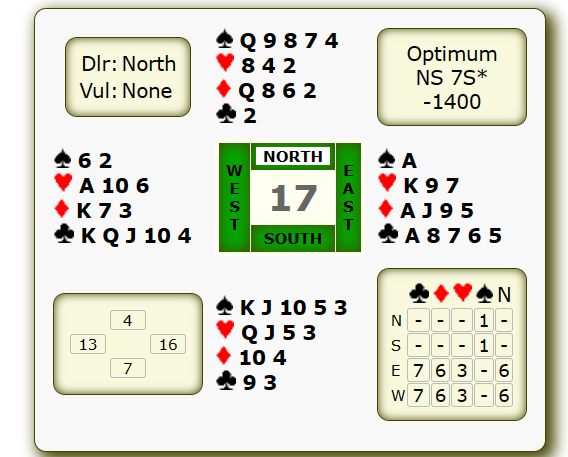
The field seemed to have had a problem with this hand, as 4C-1 was a complete average, which, with 26 points between the two hands, suggests that one was left on the course. At almost all tables, South opened 1S (one South without a pulse passed), and West usually overcalled 2H. North passed and the spotlight turned on East.  There is no way to show both minors. 3D was chosen by many, and now I think it is right for West to bid 3NT and for East to pass that. At one table, East, not unreasonably, continued with 4C and I think West should then bid a firm 4NT, saying "I told you last turn that I have a solid spade stop, partner. I still have". 

The leopard here cannot change its spots, and 4NT makes in some comfort. Indeed the defence has to cash both spades after the ace of clubs is knocked out, or declarer will make 11 as happened at one table, resulting in a top for EW. The top for NS was 4H-5, with North sensibly not doubling. A correction to 4NT would have punished his greed.


Wednesday, 20 March 2024

Kickback by Foxymoron

The expression "kickback" arose from the automotive industry as a reaction from an engine, and is also the build up of pressure in a wellhead. With the growth of the Mafia in the early twentieth century it became used for an illegal bribe or an undisclosed rake-off from collected revenue. The great film Bugsy featured Warren Beatty as the gangster getting a kickback from money due for the mob and this led to his execution. About a $2,000,000 kickback. Which was "a lot of money in 1947" as they say.

As you may know, Warren Beatty married his co-star Annette Bening, who played Victoria Hill, and they are still married today. And it wasn't for the $2 million!

Kickback in bridge refers to a bid above the agreed trump suit as an ace-asking bid. You need to know when it is kickback and when it is natural or disaster will beckon. And you need to agree when it applies and when it is just a cue-bid. Stefanie and I would have benefited from such an agreement on the following hand yesterday. We were guessing and I guessed wrong.

We started normally with (Pass)-1C-(1S)-2S-(3S). 2S was a good raise to 3C, about 10+, usually with five clubs. Now it would have been good to find out about West's keycards, but 4C by East would be non-forcing, and not Minorwood which we do play. I made the poor bid of 5C, and I think I should have bid 4D, a cue for clubs. West would bid 4H and I might then bid 6C, which is an excellent contract. I was reluctant to bid 3NT on the East hand, as we are likely to only have a single spade stop, and I did not want to bid RKCB as the response of 5D would force me to bid slam. 4D, kickback, which we have now agreed when 4C is non-forcing, would have found out about the two key cards and the queen of clubs. A good suggestion of Stefanie's.

Five Clubs and Six Clubs are interesting contracts. In the former, I played my best line for 13 tricks of playing a diamond to the king and a diamond to the jack, which worked well and scored +440. At least I beat the two pairs that cashed out in 3NT for +430. Six Clubs is a different kettle of fish. You will get a big score if you make it, so don't worry about the overtrick. Now you should cash the ace and king of diamonds and lead low to the jack, making your contract unless South has QTxx in diamonds. 

The origin of "kettle of fish" is interesting. The earliest use as "something very different" seems to be the London Mercury of 1923:


Wednesday, 28 February 2024

Major Tom by Foxymoron

Ground Control to Major Tom
Your circuit's dead, there's something wrong


We had a normal enough auction yesterday to what seemed like the best contract, but there was something wrong. We scored well below average on the board, and I decided to do some analysis of the auction.


We had what seemed like a standard auction, 1D-1S-2C-2D-All Pass. And I managed to make ten tricks. The problem is that people were making nine in spades, so my +130 was not great. Computers are getting better at bridge and they are more helpful than ever before. Plugging the two hands in to Bridge Dealer revealed that the best contract was 2S, and my partner might have bid that. The textbooks say that with a weak hand you should give what is called "false preference" but rebidding the five-card major is probably better. It is quite likely to be a 5-2 fit, and why would you want to play a 5-2 diamond fit at matchpoints in preference to a 5-2 spade fit? 

The defence to 2D is interesting. Say that the defence starts with the ace of hearts and East discourages. Now a club switch holds declarer to eight tricks. East can play a second club and if declarer draws trumps, West will be able to cash two clubs. 2S is also tricky. The defence has to set up their club tricks and only the ace of clubs lead hold the declarer to eight tricks. West can win a heart and play two more rounds of clubs to promote a second trump. An unlikely defence

Major Tom is right. Choose a major over a minor if you have a five-card suit and would otherwise have to give false preference. Some would open the East hand a weak no-trump, far too strong in my book. But they are rewarded when West transfers to spades and East plays in 2S. And the lead of the ace of hearts is surprisingly fatal.


Wednesday, 21 February 2024

Lead Balloon by Foxymoron

The expression lead balloon, which means a complete failure, seems to originate from about 1924, when the phrase appeared in a "Mom N-Pop" cartoon which I have been able to locate:


It is claimed that Keith Moon described a bad gig as being "like a lead balloon" and this led to the naming of the pop group Led Zeppelin. That accords with the group being heavy metal, as a lead balloon would certainly be heavy.

I have only seen the phrase used occasionally in bridge, and it was suggested in one article that a lead balloon was an opening lead that blew several tricks so was a complete failure. When defending 1NT doubled yesterday, we managed to make four tricks fewer than our entitlement, and that was a top to bottom swing.


East opened 1NT, 12-14, in third seat, and my double as South ended the auction. I led the king of clubs, and North played the jack, the normal card, promising the ten. I did not know whether partner had JTx or Jx (or even a singleton jack), so decided to continue with the king of clubs and a small club, establishing my eight. North discarded the eight of hearts, reverse attitude, on this. East now led the king of hearts which I won and partner played the seven. If anything that suggested a spade from South, but East could have the king or queen in which case North will have something in diamonds. I cashed the eight of clubs, and partner discarded the three of hearts, which may well have been forced. I decided to play a diamond, but that just led to an overtrick. A spade switch would have been more successful, collecting +300, and an initial spade lead more successful still, collecting +500 as the defence now has eight(!) tricks in the black suits. North did not want to discard a diamond as that might be expensive if I had an honour, and a spade might also cost if I had Axx in the suit. 

At least we conceded the overtrick, which was -280, and we did not have to put up with the opponents chanting "ONE HUNDRED AND EIGHTY" in the style of the darts fans at Ally Pally. And I nearly forgot. Lead is one element whose chemical symbol (Pb) has none of the letters of the element. Can you name the other eight? No googling the periodic table!


Wednesday, 14 February 2024

Points Schmoints by Foxymoron

A quiz at the Pula Bridge Festival invited participants to identify the authors of various books and one was the book below which I bought some years ago, so I had no problem naming him. It is a wonderful title and after you read it you should adjust your thinking to reflect the quality of the points you hold and their relevance to the auction. You can find the author easily!


Early on, I opened the following hand 1NT as dealer. I should not have done as I was vulnerable. Especially as the K-R for the hand is a paltry 11.35. I was a bit surprised to find out it was so low as the tens and nine appear to be working.

Of course it went "All Pass" and I went for the "kiss of death" of -200. I was grateful to find that I scored 15% for this effort. The phrase "kiss of death" has an interesting origin. Most people associate it with Judas Iscariot betraying Jesus Christ with a kiss, but others believe that the phrase refers to a practice among the American Mafia of bestowing a kiss on someone who has betrayed the Mafia don and is therefore marked for death.

Licking my wounds, I needed a chunky 15 count for my next 1NT opener.


The North hand weighs in at 14.40 despite the barren shape, but game is unlikely when partner has passed so I chose to open a 12-14 1NT. I thought this was better than opening 1C on the three-card suit. East doubled, although I would have shown my hearts, presumably with the popular 2D, Multi-Landy. Nigel Freake, South, bid 3C and West intended his double as takeout, but East thought it was penalties and 3C doubled became the final contract. A common problem and there was no defence so North-South notched up +470 and a top. 


Wednesday, 7 February 2024

Morton's Fork by Foxymoron

Morton's Fork was named after John Morton, Archbishop of Canterbury under Henry VII in 1486 and Lord Chancellor in 1487. He argued that someone living modestly must be saving money, and therefore could afford to pay tax, whereas someone living extravagantly was obviously rich, and therefore could also afford to pay tax. In bridge it is used when a defender has a choice of two actions which fail in different ways.

Cardinal John Morton in a stained glass window

Shelley Shieff showed her understanding of the principle in the following hand, and your scribe and his partner were the victims.


The auction was Pass-Pass-1D-1NT-Pass-2C*-Pass-2S-Pass-4S-All Pass. 2C was Stayman and Andy Clery's raise to game showed justified confidence in his partner's card-play. 

South, Graham Horsecroft, led the queen of spades and East won, ruffed a diamond, and led the queen of clubs. North, Paul Lamford, ducked and declarer, Shelley Shieff, continued with a second club won by the ace, and now ruffed another diamond, ruffed a club, and ruffed a third diamond. Now she led the king of hearts from dummy and North was caught in Morton's Fork. If he won the ace, he was forced to lead a red suit, conceding the tenth trick. Instead he ducked, but Shelley played a club throwing a heart from East. South ruffed and played the jack of spades but East won and led the ace of diamonds. South could ruff, but now the seven of spades was declarer's tenth trick. Very nicely played.

And I nearly forgot about last week's poser. As a mathematical site shows, the chance of a host NOT getting a game at the Woodberry is the sum of the sequence 0, 2, 4, ... 2^n in a Poisson distribution. This works out to be
lambda is the average number of people who turn up without a partner, which my records show is about 1.2. This works out to be 54.5%. So the host is more likely to go home (or to the pub to watch Forest v Arsenal in my case).

I don't think I need to add to Andy Conway's analysis of the chance of there being a fifth Tuesday game.


Thursday, 1 February 2024

Slam Dunk by Foxymoron

The phrase “slam dunk" was first used by Los Angeles Lakers announcer Chick Hearn. it is now used about something that is easy to achieve, but originally was a basketball shot where the player is tall enough and athletic enough to get his hand above the basket and drop it in.

On a fifth Tuesday, there is usually a different format to matchpoints, and the simplest to organise is IMP pairs, in which bidding games (and slams) gets a much higher reward. I thought one hand on Tuesday was a "slam dunk", or a "grand dunk" I suppose. However it transpired that only the winners, John Bernard and Mike Bull, managed to bid the grand.


This does look easy, but hindsight is a wonderful thing. Assuming silent opponents NS might bid 1D-1H-3D-4D (which my regular partner and I play as ace-asking, or minorwood) - 5C(2 key cards plus the queen of diamonds)-7D. South is known to have at least AKQxxx in diamonds, and needs some extras for his 3D jump rebid. The worst that can happen is that it needs hearts 2-2, opposite Kx xxx AKQxxx Kx, and it will be cold if South has a doubleton heart or the queen. On the actual hand it makes even if hearts are 4-1.

As I was host this week, I had some spare time and amused myself by calculating 

a) the chances of the host getting a game. You need to know the average number of people who turn up without a partner, and that historically is about 1.2.

b) the chances of the month that you are in having a fifth Tuesday.

I will revert, as they say.